
The OpenClaw Advisory Surge and the Blind Spot No One Saw Coming
In early 2026, a GitHub project called OpenClaw went viral. It was marketed as a self‑hosted AI agent capable of automating tasks across external services. Developers embraced it. Researchers examined it. And within weeks, something unprecedented happened.
OpenClaw published more than 200 security advisories in an extremely short period. Not quietly. Not internally. Publicly.
But the real story is not the number of vulnerabilities. It’s what those disclosures revealed about the global vulnerability‑tracking ecosystem itself.
A system designed for slow, manual coordination was suddenly confronted with automated, high‑volume reporting. And it cracked.
The Scale of the Problem
According to multiple reports, OpenClaw’s advisory page now lists around 255 GitHub Security Advisories (GHSAs). These issues span:
- command execution controls
- authorization checks
- allowlist enforcement
- plugin boundary failures
The disclosures arrived faster than any traditional Common Vulnerabilities and Exposures (CVE) assignment workflow could handle. And that created a structural gap:
Most of these advisories do not have CVE identifiers.
This is not a minor administrative detail. It is a fundamental visibility problem.
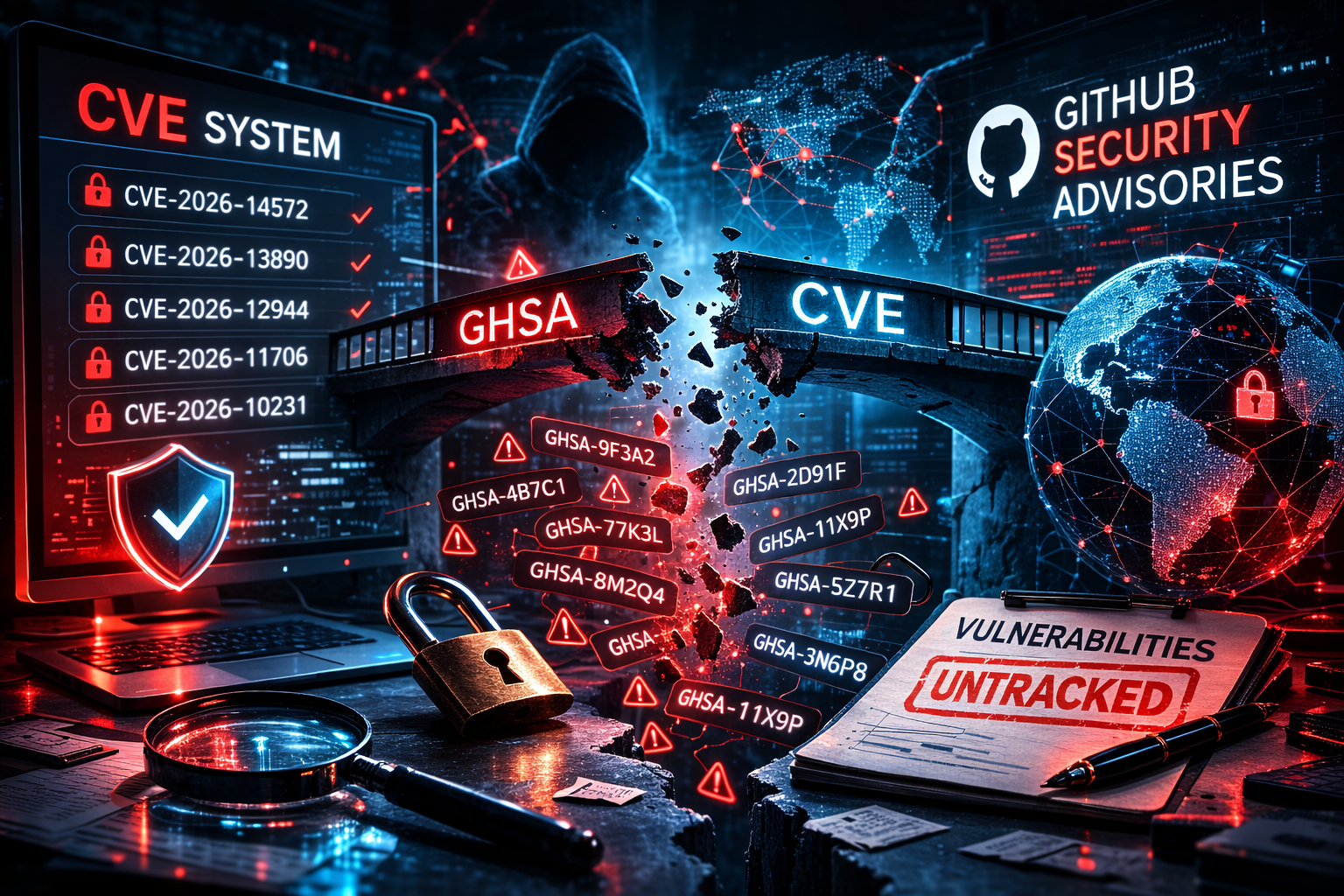
GHSA vs CVE: Two Systems Moving at Different Speeds
GitHub Security Advisories (GHSAs) can be published instantly. CVE identifiers require coordination, review, and approval.
When a project produces vulnerabilities faster than CVEs can be assigned, two things happen:
- Security teams see incomplete data.
- Enterprise tools miss real vulnerabilities entirely.
Many organizations rely exclusively on CVE feeds for:
- vulnerability scanning
- patch management
- Software Bill of Materials (SBOM) validation
- compliance reporting
If a vulnerability exists only as a GHSA, it may never appear in those systems.
This is not a theoretical risk. It is happening now.
The Failed Attempt to Bridge the Gap
VulnCheck, a vulnerability intelligence firm, attempted to “call Distributed ID Block System (DIBS)” on roughly 170 OpenClaw advisories—an informal signal within the CVE ecosystem indicating an intent to evaluate those vulnerabilities and potentially assign CVE identifiers.
MITRE rejected the request.
The DIBS mechanism was never designed for bulk claims, and the request was closed. The result: Hundreds of known vulnerabilities remain without CVE identifiers, despite being publicly disclosed.
This is the blind spot.
Why This Matters More Than People Realize
Most organizations assume:
- If a vulnerability is public, it is tracked.
- If it is tracked, scanners will detect it.
- If scanners detect it, it will be remediated.
OpenClaw proves all three assumptions can fail simultaneously.
A vulnerability can be:
- public
- documented
- acknowledged
- exploitable
and still remain invisible to enterprise security tools.
This is not a failure of developers. It is a failure of the ecosystem.
A System Not Built for AI‑Driven Velocity
OpenClaw’s surge is not an anomaly. It is a preview.
AI‑assisted development accelerates everything:
- code creation
- code modification
- code review
- vulnerability discovery
- vulnerability disclosure
But the CVE system was built for a different era—one where disclosures were slower, manual, and infrequent.
Now, a single project can generate hundreds of advisories in weeks. The infrastructure cannot keep up.
The Human Factor: Why the Gap Persists
People trust the systems they use. They assume:
- GitHub advisories are automatically integrated into scanners.
- CVEs are assigned promptly.
- Public disclosures are synchronized across platforms.
But the OpenClaw case shows that synchronization is not guaranteed. Two parallel systems—GHSA and CVE—can drift apart.
And when they do, organizations are left with partial visibility.
Security fails not because people ignore vulnerabilities, but because the system hides them.
What Organizations Should Do Now
If your environment depends on open‑source software, automation tools, or AI‑driven agents, you cannot rely on CVE feeds alone.
Practical steps include:
- Monitor GitHub Security Advisories directly.
- Cross‑reference GHSA and CVE databases.
- Track projects with unusually high advisory volume.
- Review unpatched advisories manually.
- Maintain internal mapping between GHSA IDs and CVE IDs.
- Treat missing CVEs as a risk signal, not an absence of risk.
Security in 2026 requires multi‑source intelligence. No single feed is complete.
The Quiet Truth
OpenClaw did not break the vulnerability ecosystem. It exposed it.
A system built for slow, human‑paced disclosure is now facing automated, high‑volume reporting. The gap between GHSA and CVE is no longer theoretical. It is measurable, visible, and already affecting organizations.
The next major breach may not come from an unknown vulnerability. It may come from a known one— published, documented, and ignored because it never received a CVE.
The threat is not invisibility. It is misalignment.
And unless the ecosystem adapts, OpenClaw will not be the last project to reveal it.
Leave a Reply