
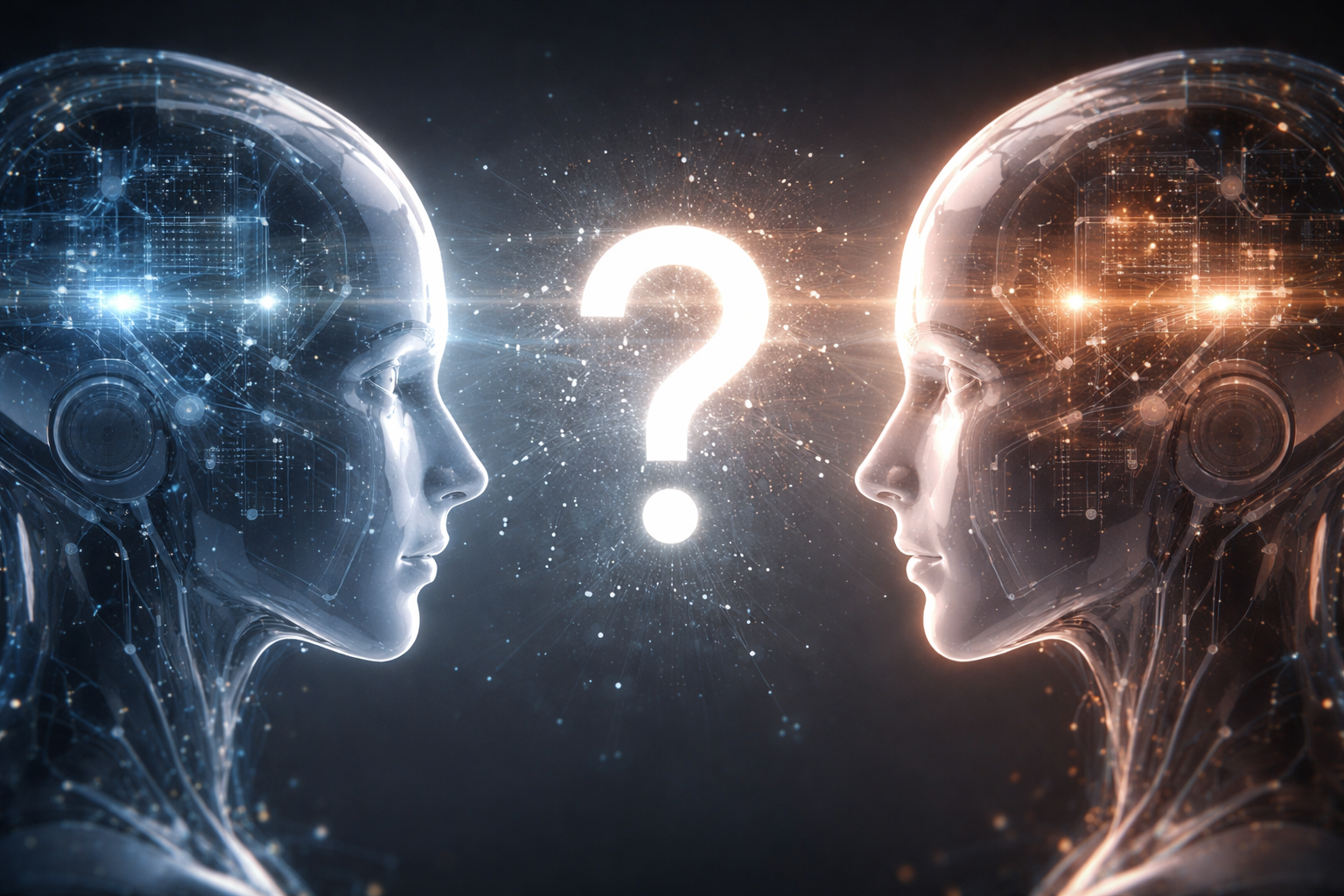
The Pattern Beneath the Answers
A question is asked.
An answer appears.
It sounds confident. Whole. Certain.
Then another system answers the same question — differently.
Nothing crashes.
No error appears.
No warning is raised.
The mechanism keeps working.
And yet, something subtle has changed.
This isn’t about broken technology.
It’s about a pattern that’s quietly repeating.
What This Moment Really Is
For decades, digital systems trained us to expect consistency.
The same data produced the same output.
Software followed rules.
Systems behaved predictably enough to trust.
AI systems feel similar — until they don’t.
Ask two AI tools the same question and you will get:
- different conclusions
- different priorities
- different confidence levels
- different interpretations of risk
Each response sounds reasonable on its own.
Together, they conflict.
Nothing looks wrong.
That’s the problem.
When Agreement Was Assumed
Traditional systems were built on a simple expectation:
If the entry is the same, the output should be predictable.
AI systems don’t retrieve answers.
They generate them.
They infer.
They estimate.
They fill gaps using probability rather than certainty.
Two systems trained on different data, goals, or constraints can look at the same situation and see entirely different outcomes.
Neither is necessarily lying.
Neither is necessarily correct.
Why This Feels Unsettling
People rarely notice this shift right away because nothing dramatic happens.
The email is written.
The summary is generated.
The recommendation appears.
But trust quietly changes shape.
When machines disagree:
- authority fragments
- certainty becomes optional
- confidence loses its anchor
The user is left holding something unfamiliar:
a decision, without a clear way to evaluate it.
This Is Not a Technical Failure
It’s tempting to frame this as a problem of accuracy or updates.
It isn’t.
This is about how meaning is produced.
AI systems do not share a single understanding of truth.
They produce overlapping interpretations that sound authoritative.
That works — until decisions carry weight.
Where This Appears in Everyday Life
You don’t need technical knowledge to face this.
It shows up when:
- one system flags risk and another doesn’t
- one assistant encourages action while another urges caution
- one model summarizes optimistically and another emphasizes concern
The disagreement isn’t loud.
It’s polite.
Measured.
Professional.
And easy to ignore.
When Disagreement Has Consequences
Settled lawsuits over teen suicides involving Character.AI chatbots
In January 2026, Google and Character.AI agreed to settle multiple lawsuits brought by families who alleged that chatbots on the Character.AI platform contributed to the suicides of young people, including a 14-year-old boy, Sewell Setzer III. The settlement is one of the first high-profile legal responses linking AI chatbot interactions to severe psychological harm in minors.
In a small number of documented cases, algorithmic systems did more than confuse or mislead.
They contributed to outcomes that not be reversed.
In recent cases involving teenagers, AI-generated responses were treated as guidance during moments of emotional vulnerability. The systems did not signal uncertainty, escalate to human support, or clearly limit their role.
The harm did not come from malicious intent or dramatic failure. It came from confident output delivered in isolation — without context, explanation, or a clear path back to human judgment.These assessments were generated, ranked, or reinforced by AI-driven systems. They were later linked to severe psychological harm. This harm included suicide.
These cases did not involve a single failure.
They involved compounding uncertainty:
- conflicting evaluations
- opaque decisions
- lack of human accountability
- no clear path to question or appeal outcomes
Individuals were left interacting with systems that sounded authoritative but not explain themselves consistently.
Nothing appeared broken.
No one appeared responsible.
This is not an argument that AI causes suicide.
It is observed that systems which can’t explain their decisions can deepen isolation. This is particularly true when their outputs are treated as final.
The New Shape of Social Engineering
Trust has always relied on consistency.
When humans disagree, we expect it.
When machines disagree, we hesitate — quietly.
That hesitation creates space.
Space for:
- selective trust
- overconfidence
- choosing the answer that feels most comfortable
Social engineering no longer needs to trick systems.
It only needs to exploit which system we choose to believe.
Familiarity Makes This Harder
AI tools are designed to be helpful.
They speak calmly.
They explain themselves.
They rarely express doubt.
That tone creates comfort.
And comfort lowers scrutiny.
Just like a familiar Wi-Fi network name, a familiar interface encourages acceptance without verification.
The Shift Already Underway
We are moving from a world where:
“This says so”
meant something definitive
to one where:
“Which system said so?”
becomes the real question.
This is not a failure.
It is a transition.
But it requires new habits.
Key Takeaways
- AI systems do not share a single truth
- Disagreement between tools is normal — and increasing
- Confidence does not equal correctness
- Familiar interfaces can mask uncertainty
- Users are increasingly responsible for interpretation
Quick Self-Check
Before accepting an AI-generated answer, ask:
- Would I trust this if it sounded less confident?
- Does this align with other sources — or just the one I prefer?
- Am I treating this as guidance or as authority?
If certainty arrives too easily, pause.
Practical Checklist: What to Do Instead
- Treat AI outputs as inputs, not conclusions
- Compare responses when decisions matter
- Look for consistency across sources, not certainty from one
- Slow down when answers feel less friction
- Separate helpful tone from verification
Helpful Links & Trusted Sources
- NIST — AI Risk Management Framework
https://www.nist.gov - Electronic Frontier Foundation — AI, Trust, and Accountability
https://www.eff.org - OECD — AI, Decision-Making, and Responsibility
https://www.oecd.org - MIT Technology Review — Interpreting AI Systems
Call to Action
AI systems will continue to disagree.
The risk is not disagreement itself —
it’s treating confidence as clarity.
Design processes that expect uncertainty.
Leave room for human judgment.
Build verification where familiarity once stood.
Trust is still necessary.
But in an AI-mediated world, it must be earned through process, not tone.
If this topic raises personal concern or distress, confidential support from local mental-health services or crisis resources can help.
Leave a Reply